

Understanding the MISO Planning Resource Auction Changes
2 min readInterested in understanding whether there are enough resources available to meet expected peak demand and maintain grid stability? The Midcontinent Independent System Operator (MISO), which manages the electric grid across 15 U.S. states in the Midwest and the South, plays a key role in this process through its Planning Resource Auction (PRA). By understanding the basics of the PRA, the reasons behind recent increases and options available, businesses can make informed decisions and plan effectively.
Exploring the MISO Planning Resource Auction
The MISO PRA is held annually as a tool for electricity suppliers to procure enough available power to meet projected demands at peak times throughout the upcoming planning year. Through the auction, MISO ensures a competitive market environment where electricity generation resources can offer capacity, and electricity suppliers can purchase what MISO expects they need to serve their customers during peak periods.
Takeaways from the 2025/2026 PRA Auction
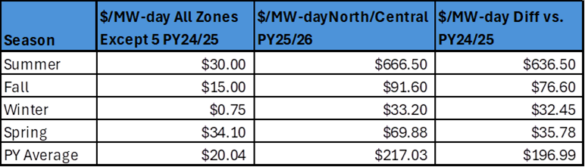
The latest PRA cleared resources for the planning year (PY) that runs from June 2025 to May 2026 (PY 25/26). MISO was able to clear enough resources to meet the resource adequacy requirements for PY 25/26 throughout its footprint. On an annualized basis, PY 25/26 prices cleared ten times higher than PY 24/25, up to $217/MW-day, compared to $21/MW-day for PY 24/25.
MISO noted that the 2025/2026 resource adequacy requirements were met. However, the amount of surplus capacity was 43% lower compared to the previous summer, despite having a slightly lower summer Planning Reserve Margin target of 7.9% (down from 9% last year). These results show a tight supply-demand balance and send a signal encouraging investment in resources, as demand is expected to grow. New capacity additions did not keep pace with decreased accreditation, suspensions and retirements, and fewer external resources.
Impact of the Reliability-Based Demand Curve (RBDC)
This year’s auction was the first to be conducted with the Reliability-Based Demand Curve (RBDC) in effect. The RBDC is designed to create stable price signals that reflect seasonal risks and tightening surplus, leading to more efficient outcomes. In the 2025 PRA, the RBDC evaluated findings from the Loss of Load Expectation (LOLE) Study Report, which examined seasonal risks, tightening surplus and incremental capacity needs.
Summer 2025 cleared at $666.50/MW-day, reflecting the highest reliability risk due to year-over-year reductions in surplus capacity. That surplus has steadily declined from approximately 6.5 GW in 2023, to 4.6 GW in 2024 and down to 2.6 GW in 2025.
What’s Next for MISO Customers
The PRA results were posted on April 28, and new prices have taken effect starting June 1. As the market adjusts to tighter supply conditions and evolving reliability standards, it’s essential that businesses are proactive in implementing an energy strategy. Constellation offers a suite of MISO products that provide different levels of protection to help manage risk and navigate these market changes. To learn more about how these solutions can support your business’s goals, reach out to a Constellation Sales Representative today.
© 2025 Constellation. The offerings described herein are those of either Constellation NewEnergy, Inc., Constellation NewEnergy-Gas Division, LLC or Constellation Navigator, LLC, affiliates of each other. Brand names and product names are trademarks or service marks of their respective holders. All rights reserved.