

The Impact of Standard Supply Service on Clean Energy Buyers
4 min readIn an energy landscape where sustainability is a top priority, businesses supporting clean energy should be able to claim these purchases in their Scope 2 greenhouse gas (GHG) emissions inventories (Scope 2 emissions are indirect emissions from purchased electricity, steam, heat and cooling). The GHG Protocol, the organization responsible for the leading comprehensive global framework for measuring and managing GHG emissions from private and public sector operations, value chains and mitigation actions, recently requested public comments on proposed updates to its Scope 2 guidance1. There has been a lot of discussion about certain aspects of the proposal, including hourly carbon-free energy matching and deliverability reporting requirements. However, one important change, known as “Standard Supply Service”, has received limited attention but is critical for clean energy buyers to understand.
Understanding Standard Supply Service
According the GHG Protocol, Standard Supply Service is clean energy “from publicly funded, mandated, or shared resources such as those delivered through default utility service or government clean energy programs”2. Today, many customers are paying for this clean energy but have no way to “take credit” for it in their own GHG inventories. Customers in jurisdictions with mandatory procurement programs – such as clean energy standards, renewable portfolio standards and similar policies – should be able to claim the share of clean energy purchases they support through these policies. Likewise, if a vertically integrated utility charges customers for the development and operation of clean energy resources, those customers should be able to claim their share of that clean energy. And if a clean energy resource is publicly owned and operated, its output should be allocated to all the consumers in the jurisdiction where the energy is delivered and consumed. However, under current rules, businesses aren’t entitled to claim the clean energy purchased on their behalf or in connection with their load.
Standard Supply Service reflects simple property rights: if you pay for something – in this case, clean energy procured under a mandatory program – then you are entitled to claim it. On the other hand, you are not entitled to claim the emissions benefits from the clean energy that others pay for. This principle has been a part of clean energy accounting for years and was referenced in the GHG Protocol’s 2015 Scope 2 Guidance3. Despite its original inclusion and the intent that Standard Supply Service clean energy could be claimable by ratepayers, the guidance caused confusion due to conflicting statements about mandatory clean energy and the “order of operations” in Table 6.3 of the 2015 Scope 2 Guidance4.
Since 2015, many energy professionals have addressed this lack of clarity. They agree that ratepayers should be able to claim their share of standard delivery clean energy from their default electricity service as long as there’s a meaningful financial relationship between those generating assets and rates paid5.
Exploring the Proposed Guidance
The GHG Protocol’s proposed updates align with the growing consensus among energy professionals that credit for mandatory clean electricity should be allocated to customers who pay for it. This principle applies equally to Standard Supply Service.
The proposed revisions also provide clarification on the order of operations in market-based calculations. They explain the relationship between supplier-specific emission factors and Standard Supply Service, so customers can claim their share of Standard Supply Service clean energy before applying an emission factor to any unmatched electricity use.
In the U.S., many retail suppliers already provide supplier-specific emission rates. For suppliers like Constellation NewEnergy, Inc. (Constellation), we make the process simple and transparent by calculating the emission rate and showing customers exactly how we include their share of Standard Supply Service clean energy. Below are some examples of Standard Supply Service allocation in practice.
Maryland – Constellation
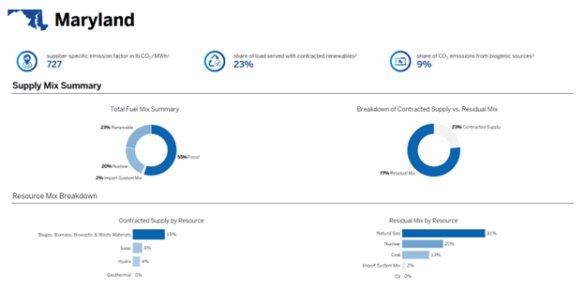
In Maryland, Constellation purchases clean energy attributes as part of the state’s renewable portfolio standard (RPS). Along with our supplier-specific emissions factor, we report the fuel type of the resources generating the attributes that we purchase to meet the RPS obligation. Under the proposed rules, customers will be able to claim the purchases of energy attribute certificates from emissions-free resources directly in their Scope 2 market-based inventories.
Illinois – Commonwealth Edison (ComEd)
In Illinois, ComEd retires clean energy attributes from existing nuclear generation as part of the Zero Emission Credit (ZEC) and Carbon Mitigation Credit (CMC) programs designed to extend the life of nuclear plants in the state. ComEd ratepayers can claim these certificates, which are conveyed via ComEd’s utility specific residual mix disclosure. In 2023, 87% of load for ComEd ratepayers was matched with certificates retired under these programs. Another 3% wind and 3% solar was backed by certificates retired for compliance with the Illinois RPS, meaning on an annual basis in 2023, up to 93% of load served by ComEd could be claimed with a zero-emission rate in the market-based inventories of reporting companies in the ComEd service territory.
Getting Credit for Your Clean Energy Purchases
The public consultation period, which is when all stakeholders have an opportunity to provide feedback on proposed updates, will end on January 31, 2026. Participating in this consultation process can help shape how businesses account for and report electricity-related emissions in future climate disclosures and target setting programs based on the GHG Protocol for years to come. You can review the consultation materials and complete the survey on the GHG Protocol’s website.
Contact your Constellation representative to learn more about how Constellation can help decarbonize your energy supply through renewable energy certificates, Constellation Offsite Renewables or hourly carbon-free energy matching.
[1] https://ghgprotocol.org/blog/upcoming-scope-2-public-consultation-overview-revisions.
[2] https://ghgprotocol.org/sites/default/files/2025-10/GHG-Protocol-Scope2-Public-Consultation.pdf.
[3] See sections 6.6, p. 49; 6.11.3, p. 55-56; and 9.4.1, p. 76-77.
[4] See page 48.
[5] Center for Resource Solutions (CRS), Clean Energy Buyer’s Alliance (CEBA), RE100, Regulatory Assistance Project (RAP), and the U.S. White House Council of Environmental Quality.
© 2026 Constellation. The offerings described herein, if applicable, are those of either Constellation NewEnergy, Inc. or Constellation NewEnergy-Gas Division, LLC, affiliates of each other. Brand names and product names are trademarks or service marks of their respective holders. All rights reserved. The views, thoughts and opinions expressed in the blog and podcast by each participant belong solely to the speaker and not necessarily to the speaker’s employer (including Constellation Energy Corporation or any of its affiliates), organization, committee or other group or individual. Constellation does not make and expressly disclaims, any express or implied guaranty, representation or warranty regarding any opinions or statements set forth herein or in the webcast. Constellation shall not be responsible for any reliance upon any information, opinions, or statements contained in the webcast or for any omission or error of fact.